Showing posts with label not cliche. Show all posts

Sunday, November 15, 2015

World Building, Part 6: The Sword!

Because Heroes Prefer Swords

My own sketches, pre-Graey Erb
This is not news.  A trope older than Beowulf and Iliad, literature both ancient and modern is full of examples that prove the trope.  Some ask why, and the simple answer is that a blade has been present in warfare for almost as long as war has been waged (considering someone had to figure out how to make them, first).  Even today soldiers bring a knife to their gunfights, and while there are no longer epic sword fights outside of Medieval Times and Renaissance Fairs, swords remain strongly embedded in how we think of war.  Therefore, it is natural that in fantasy settings, swords seems to always find their way into the hands of a hero.  The above link goes into some detail regarding examples in literature, and literary trends related to it, so instead I will tell you about The Sword of my book, and why I found it necessary to design this particular aspect of the book and bring it to life through art so early in my writing process.


My pommel design sketch.
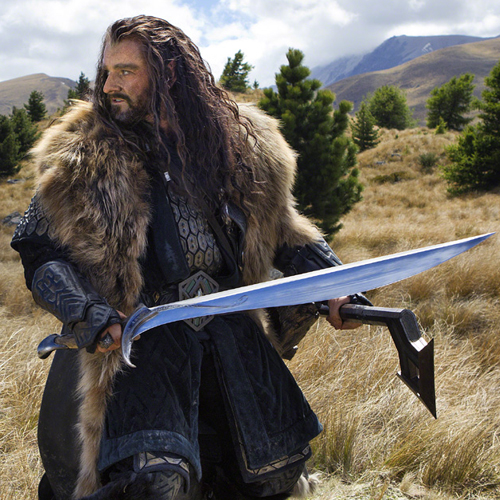
Before I hired Graey Erb to create artwork, I tried my hand at drawing things myself.  Above I was toying with the shape of the blade.  I was inspired by the design of Orcrist from "The Hobbit" movies (shown on the right).  Big surprise, I'm sure.  Truth is at the beginning, I imagined The Sword for my protagonist would be like Anduril, considering my unrefined excitement for "The Lord of the Rings."  Further thought and time eventually told me that a European long sword seemed out of place among lizard folk.  It is much more common to find lizard folk or any of the other 'evil minion' labeled races having some manner of cruelly shaped curved swords.  This comes from history as much as literature, as European Christians demonized the pagan tribal peoples of Eastern Europe and the Muslims of the Near East, both of whom of battled various European kingdoms either across land or the Mediterranean Sea (Crusades, anyone?).  These cultures used curved blades that fit their tendency to attack from horse back, where a curved blade would be more practical than the straight edged blades that dominated Western Europe's armories.  This allowed me to tackle and subvert another common trope, referred to as the Sinister Scimitar.  In essence, my desire to subvert the "Reptiles are Abhorrent," which claims that lizard-beings are almost always evil, gives me the chance to subvert the trope claiming bad guys use curved swords.

Curved swords!
The first draft of Graey Erb sword concepts.
In order to create a fitting visualization of the sword I wanted, I emailed Graey (after discovering his art on Pinterest of all places) with a 20+ page project proposal that included my own sketches for designing the sword.  The first draft of concepts were very different from each other, as I did not have a clear idea of what the sword would look like.  The initial idea was that the sword was created during a Golden Age of the World.  Since the Deities of this world have (or can choose to have) a draconic form, the weapons are made to evoke that.  The pommel is shaped as the head of a dragon, the hilt is the neck/body, the crossguard the wings, and the blade has a tail either engraved or embossed upon it in some fashion.  After seeing the first draft, I pointed out what I liked and disliked, and Graey went back to work, creating a second set of concepts.  The one I liked the most, and that Graey iterated upon, was a combination of features from #1 (The pommel, crossguard and blade shape) and from #3 (the hilt texture and the style of detail on the blade).  I also asked him to work on the proportions of sword, such as making the blade longer and thinner.  The other designs, despite not being quite what I had in mind, actually gave me some ideas.  Numbers 5,6 and 10, with the angular design elements reminded me of the dwarven architecture in "The Lord of the Rings" and "The Hobbit" movies, so it gave me the idea that these designs could be reused when I get around to developing the other cultures that will be in my book.

Concept Pass 2
The second set of concepts nailed down the size and shape of the sword, leaving the details on the blade itself to be choose.  I again went with #1, as the sunburst at the top seemed appropriate. It seemed too plain, still, so Graey and I came up with a stylized sun to replace the plain circle.  It ended up being two pointed starbursts overlapping each other  Next, something needed to go on between the lines radiating from the half circle.  We narrowed it down to either a diamond or a four pointed star, and settled on the four pointed star.  From there the sword was more or less complete.  With some color, the sword came to life.  There is one feature that I found unique which came from the original concepts: a medallion hanging off the pommel.  It is common among the practitioners of Wushu, a style of the 'kung fu' martial arts in China, to have a tassel hanging from the pommel of their dao, a type of broad bladed sword.  I like it as a way that my character, upon getting the sword, to personalize it without changing the sword itself.  A common trope in fantasy is the named weapon, which either comes from the blade being historical/legendary or from the character being sentimentally attached to the weapon.  I have not decided yet if I will name it or how it would be named, so the medallion seemed a good alternative.

Final Concept Pass
The Sword of the Hero!

Thursday, November 5, 2015

Things that Inspire, Part 1: Long Live the King!


Large and In Charge

Many things inspire my writing. Chief among those is "The Lord of the Rings," which I've mentioned many times, but even more so, specific things in "The Lord of the Rings" inspired specific things in my novel. For instance, my main character. In my earliest drafts, my Protagonist was inspired by my favorite character in TLotR:  Strider, aka Aragorn, son of Arathorn, heir to the throne of Gondor

Aragorn II Elessar, son of Arathorn, King of the Reunited Kingdoms of Arnor and Gondor, and all around bad ass. Early on, my main character was almost a rip off of the movie adaptions' version of Aragorn: ratty clothes, soiled leathers, elven hunting knife, born of some special legacy, gets "The Sword" and becomes "The Hero." I won't use that 'C' word but, yeah. I was a teenager and that was what I liked. Not much has changed but my character has, for the most part.

Apart from the tropes I liked, the character also appealed to me because of how the actor, Viggo Mortensen, portrayed Aragorn. In the novel, Aragorn is a character who knows that he is the heir to a kingdom and a mighty legacy, but he tends to make sure everyone knows it, too. He leaves Rivendell with the Sword of the King (unlike in the movie) and basically lets anyone who doubts him because of his vagabond appearance just who he is and why that sword he's carrying shines with the light of the sun and moon. Some quick literary analysis: Tolkien based Aragorn on the heroes of myth and legend from Northern Europe, such as Beowulf. Beowulf, if you read the translations of the surviving manuscript, is pretty much that guy who knows he's the best there is and decides, "Yeah, I can kill that beast Grendel unarmed and naked." And then does it. Then takes the next step and kills Grendel's mother. And then a Dragon. Solo. While no one-on-one monster slaying is done by Aragorn in the Lord of the Rings books, he does have some suitably heroic encounters. He faces off with all nine Ringwraiths, some of the most deadly fiends in Middle Earth, with nothing more than a mundane sword and a torch in the Fellowship of the Ring.

In the movies, however, Aragorn is portrayed as a reluctant hero. He still knows that he is the heir to a great legacy and the elves can't wait to remake that awesome sword so he can go save the world with it, but chooses a humble and honorable life as a ranger to protect those in need, fearful of the corrupting influence of power. It was that version of Aragorn, the hero that's heroic only because duty calls and would rather just be left in peace, that inspired my character. In my story, the protagonist just wanted to be a respected hunter in his village, but an encounter with an ancient plague and a need for someone to do something about it (and a dash of certain people not liking him) ends up propelling him along the heroic story arc. I don't want to spoil anything, so I won't go on any further about the plot. The other part of the character of Aragorn that inspired my own character wasn't so much something specific to Aragorn, but it's something common to the archetype Aragorn represents: The Hero. And in myths and legends, the Hero almost always has The Sword. I mentioned a few times already that Aragorn gets "The Sword" for his particular book. That sword is Anduril, the Flame of the West, forged from the shards of Narsil! Basically it's the weapon that the Bad Guy even fears because it can hurt him. Common trope. And teenage-me loved it. Get the awesome sword, be the awesome hero. Simple formula. Works just about every time. From Luke Skywalker to Eragon to Bilbo to Arthur. Getting "The Sword" means you're "The Hero," and so it shall remain for my book. Nothing new, I know, but hopefully the context within the book itself will make it better. That tends to be how these tropes work. It's not the trope itself but how it's used which makes a book unique. Again, won't divulge much, but you will see "The Sword" of my book soon. It's pretty cool.

NaNoWriMo update: Another busy day as you can tell by the late posting, but productive. Chapter 7 is under way with another 261 words typed, totaling 1277 words so far. I'm pretty sure I will get this one done this month. I have it planned out almost from start to finish, so just need to add the details. But you know what they say: The devil is in the details. Wish me luck!

Quick note:  This had pictures in it but Blogger must have messed up the html somehow, so I removed them until I can fix them.

Wednesday, October 28, 2015

World Building, Part 3: Creating a Living World

World Building

A whole new [living] world!

A dazzling place I never knew.
Aladdin © Disney

Don't judge me.

Every great story has a great setting created by a great author.  JK Rowling created Hogwarts.  Tolkien created Middle Earth.  Terry Pratchett created Discworld.  Suzanne Collins created Panem.  Whether the setting is on an imagined world, tucked creatively within our real world, or is a dystopian version of our own, these great settings did not spring forth from the ether fully fleshed out and ready to have stories told about and within them.  For Tolkien, it was his life's work that created Arda and Middle-Earth.  Years of studying old languages, creating new ones, and writing (either poetry in the trenches of The Great War or the first lines of "The Hobbit" on the back of a student's exam) culminated in the fantasy realm that inspired so many others.  The same goes for most authors.  Each took their passions and their life experiences and used them to craft their world.  And these works become the experiences of others, which then shapes the world.  There's a reason D&D, Dragon Age, and EverQuest, to name a few, all involve elves, dwarves, wizards, and dragons.  His name is Tolkien.  JK Rowling will no doubt shape the future of how people think of magic, as games, music, and even plays take inspiration from The Wizarding World of Harry Potter TM.  Each author's world has become a place others love to dwell in.

Every author seeks to draw you into their setting one way or another.  A friend of mine, Robin Dilks, self-published a paranormal romance novel that takes place in both the historical past and the present, redefining the mythology of the Biblical character Lilith in "Rachael Awakened."  (Still reading it.  Review pending.)  I was drawn into how she mixed paranormal tropes like demons, werewolves, and vampires, with historical eras like renaissance Italy.  With mine, I hope to appeal to high fantasy readers looking for something a little different, by playing with the established genre enough to make things unique and fresh.

For my story, creating the world started by figuring out some of the mythology that would be present.  Since I was following Tolkien for inspiration, that started with deciding that there would be a pantheon of deities.  From there, I had to have some sort of explanation for their existence, as well as an explanation of where the physical world came from.  I'll save the specifics for now but I ended up going with something slightly more cosmic than creationist, meaning the deities did not necessary "create" the world the story takes place in.  Shaped it, sure, but they did not "sing it into existence" like Iluvatar and the Valar did at the very beginning of "The Silmarillion."

My next step was, silly as it sounds, finding conflict.  In Tolkien's mythology, Melkor is the Big Bad Dark Lord from Day: Zero, and I sincerely wanted to do something else.  While I still wanted to play with those two tropes, I did not want my work to come off as even a little cliche (even though it probably will anyway), so I choose to take a more Lovecraftian angle toward the the Big Bad, while saving the Dark Lord bit for something else.  But I won't say more.  You'll have to read my book!

From there it was trying to decide what the world contained as far as sentients.  Most fantasy works, and especially science fiction works, have different kinds of mortal beings who interact and sometimes represent different thing.  Most times they are allegories for different real world states, religions, philosophies, or ethnicities.  "Redwall," a classic about a mouse who becomes a hero to save his little town, uses animals like mice, badgers, otters, and cats, to represent different kinds of people, with some being summarily bad (like evil rats opposed to the good mice).  Sometimes these allegorical pieces are intended and other times not, and only revealed through analysis.  I am doing some of this, but in a way where the individual cultures of my lizard people, and of any other sentients I include, will say more about what they represent then the being itself, while still letting the nature of certain beings influence that same representation.  If that sounds confusing:  You'll have to read my book!

And then it's identifying what sorts of cultures this world will have that comes next.  My story starts in a very tribal setting for a few reasons, it never stays there.  Just as LotR moves from the Hobbit filled Shire culture to the many Mannish cultures across Middle Earth (from Bree to Rohan to Gondor and back), so too will my story explore the world and its cultures.  That I think is one of the most important aspects of world building.  If you try to write a white washed world where Good here is Good there and everyone agrees that Good is Good, well it just doesn't reach the level a world that's complex and diverse.  What's Good in the protagonist's hometown might not be looked upon the same in a corrupt city where the only way to survive is to commit crimes.  That creates conflict, and conflict is what drives a story.

I wrote previously that I bounce back and forth between world building and actually writing the story.  I'm still not sure what would work best (for me or other people) but I have to say that without knowing enough about the places my characters are going, I can't write.  So if you're reading this for writing types, consider what works best for you, first, and then accept advice that you find helpful.  And always remember that if you think it will work and it doesn't, try something else.  Don't force it.  I never write well when I force it.  Thanks for reading. 

Friday, October 23, 2015

Tropes

The Building Blocks of a Narrative

First things first...

Once upon a time, over the river and through the woods, lived a farmer, who was as old as the hills, and his daughter, who was as clever as a fox.  One day, they woke up on the wrong side of the bed, and fell head over heels.  Scared out of their wits, they ran at the speed of light in the nick of time to avoid the house falling down on them.  They lived happily ever after.  The End.

The most classic of cliché, "The End."

If you've heard of any of the devices I used above before: Congratulations!  You're familiar with some of the most basic (and sadly overused) building blocks of storytelling!  We call them clichés, and they are given this unfortunate name because they are, word for word, so overused that you can't avoid them in your lifetime.  Every parent has told every child across time, at some point, some version of a cliché, either at bedtime or as a life lesson or while scolding them, etc.  These days, memes are becoming the new cliché.  But when you watch "The Big Bang Theory" on CBS and think, "Oh, Penny's blonde so she must be dumb," or you watch 'sport-of-choice' and think an athlete is dumb just because he/she/they is/is/are an athlete, congrats, cliché!  You may say, "But Shane, these are stereotypes."  Stereotypes are a type of cliché.  So enough about clichés.  If you can turn on a sitcom and figure out characters by their appearance, or see someone on the street and make a snap judgement about someone, you've 'clichéd,' and sadly that's boring.

What I find interesting is instead tropes.  Now, you may think to yourself," What's the difference?"  Or maybe, "What's a trope?"  Direct dictionary definitions aside, "a trope is a convention. It can be a plot trick, a setup, a narrative structure, a character type, [or] a linguistic idiom..." (TvTropes.org).  Generally, you know them when you see them, but they don't make you rolls your eyes and sigh thinking, "Another dumb blonde/Chinese math-wiz/antisocial scientist?"  Tropes are non-disruptive, were as a cliché is, or can be, disruptive to the storytelling.

Stormtrooper Accuracy = Cliché

A classic example of a trope is "The Captain."  Star Wars, Star Trek (and all it's spin-offs), Star Gate, Babylon 5...  you name it.  If the show has a military twist, naval or otherwise, you know The Captain.  Kirk, Picard, Solo, O'Neil, Sinclair.  I could go on, but you know that when you talk about The Captain you are referring to not just someone in charge of a naval vessel, you're talking about the guy who takes command and leads people in war.  And while they don't always carry the literal rank or title of Captain, you know who they are.  That is a trope.  It's recognizable and it doesn't get in the way.  There's no one single catch phrase or slogan that goes with it, and most of the time the individual Captains have their own.  And the trope doesn't limit the attributes of this leader like a stereotype.  Kirk and Picard are not the same types of Captain.  Han Solo goes from just 'a captain' to The Captain when he turns away form being a loner and decides to help fight the Empire.  Luke Skywalker goes from disgruntled, whiny farm-boy to a pensive, insightful Jedi and squadron leader.  None of them do the same things, but they all fit the Trope.

"O Captain! my Captain!" - Walt Whitman

I love tropes.  Why?  Because noticing tropes requires not just a familiarity with genre, but an understanding of the very conventions they illustrate.  And sometimes when you think about a particular character or story or even series, you can surprise yourself with what tropes are embedded in your favorite story.  To students of Literature, these things become plain to see after enough exposure.  For instance, what do Darth Vader, Voldemort, and Sauron have in common?  If you said, "They're all villains," then you recognize them as the classic trope of villains.  But that's just the surface.  Each one of them stem from another trope, The Evil Overlord trope.  "Wow, Shane, really?"  Yeah, yeah, stick with me.  These tropes resonate across myth and time.

Meet 'Ares'
For instance, "Gods of War."  Ares, Athena, Odin, Freya, Set, Horus, Ishtar, Bishamon.  Gods of war across the world from Greece to Japan to Norway to Egypt.  They even are applied to real people.  George S Patton, US General of the Third Army during World War Two is said to have believed he was a reincarnation of the Spartans of Greece, who were the War-Godliest people of ancient Greece.  And then there's Spartans themselves.

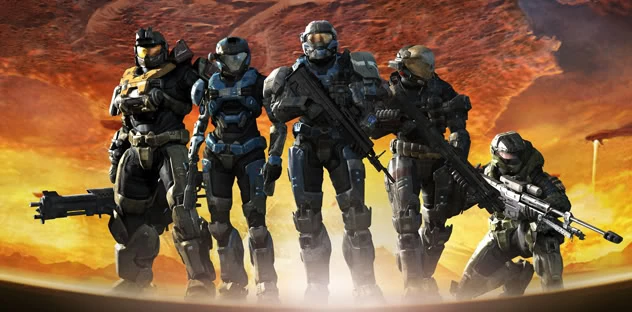
Meet SPARTAN Team Noble:
Jorge, Kit, Carter, Emile, and Jun.

How many college and high school teams call themselves the Spartans.  The fascination with Spartans in sports, movies, and video games (whether the historical Greeks, the Fictional Greeks, or the Augmented Super-soldiers of HALO) comes from our fascinations with yet another trope: The Proud Warrior Race.

I could rant for pages about tropes.  And yet I've hardly touched how deep tropes can go.  They refer to theme, plot devices, character development, character archetypes, even the things in media that don't make sense!  When people someday read my novel I look forward to people prying it apart to discover the tropes I've purposefully worked into my novel, and discovering the tropes that snuck into it.  Because it's a form of literary archaeology, a process of looking at what was used to build the story, consciously and subconsciously, that fascinates me.  So many things from the books, games, and movies I've enjoyed over time will find there way into my novel, and I can't wait to dig them up with others and discuss them.